

In Chicago, you’ll need ADA-compliant porta potties with a minimum 60″ × 60″ interior space and 32″ clear door opening. Your units must include sidewall grab bars, toilet heights between 17″ and 19″, and entry thresholds under ½”. You’re required to provide at least one accessible unit or 5% of your total fleet, whichever is greater, positioned on level ground with proper accessible routes. Federal penalties start at $55,000 for violations, while state citations can exceed this amount. Below, you’ll find detailed placement guidelines and provider selection criteria.
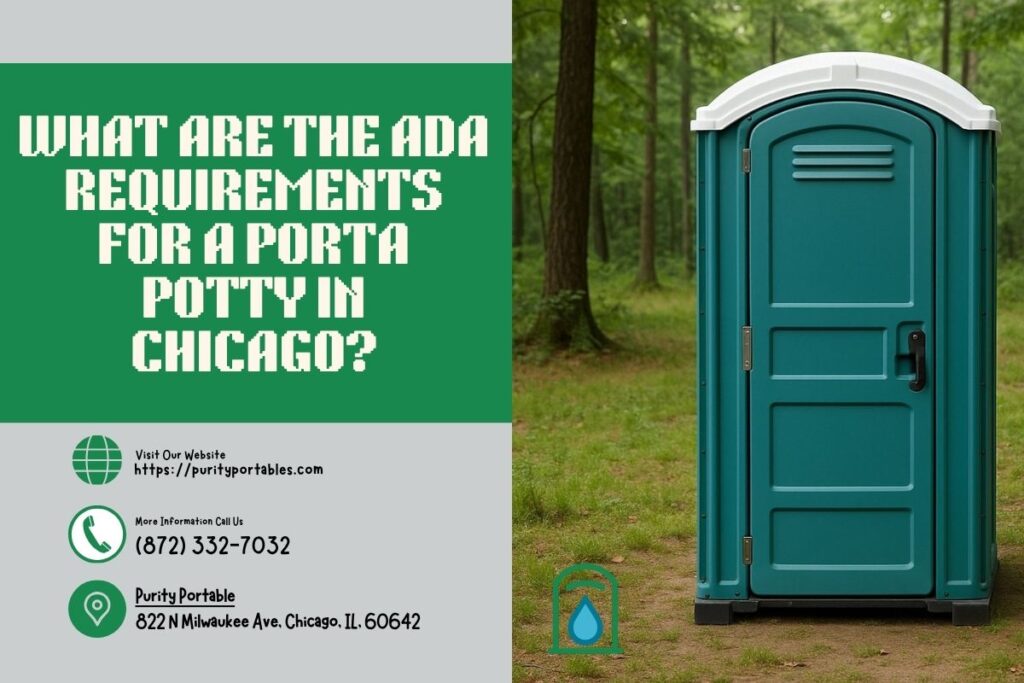
The Americans with Disabilities Act (ADA) mandates that portable restroom facilities meet specific accessibility standards when provided at public events, construction sites, or temporary installations in Chicago.
You’ll need at least 5% of your total restroom units to be ADA-compliant, with at least 1 accessible unit, regardless of fleet size. These requirements apply when you’re providing facilities for public use or employee access.
Chicago’s building codes align with federal ADA standards while incorporating supplementary municipal specifications. You’re responsible for ensuring compliance, whether you own or rent the units.
Non-compliance risks penalties ranging from $55,000 to $75,000 for initial violations. Understanding these baseline requirements helps you plan effectively and maintain legal operations while serving diverse communities throughout Chicago’s metropolitan area.
See also: ADA compliant portable toilet rental service near Chicago
When determining ADA compliance for portable restrooms, you’re addressing an extensive set of federal standards that govern physical dimensions, maneuverability, and usability features. These regulations guarantee accessibility for individuals with disabilities through specific technical requirements.
| Component | Standard Requirement | Purpose |
|---|---|---|
| Interior Space | 60″ × 60″ minimum turning radius | Wheelchair maneuverability |
| Door Width | 32″ clear opening minimum | Accessible entry/exit |
| Grab Bars | Horizontal bars on sidewalls | Transfer support stability |
| Toilet Height | 17″-19″ from floor | ADA-compliant seating |
| Entry Threshold | ½” maximum height | Barrier-free access |
ADA compliance transforms standard portable restrooms into facilities that meet legal requirements and accommodate diverse mobility needs. You’ll need units specifically engineered to meet these federal standards, not retrofitted conventional porta potties.
Compliance with ADA standards protects Chicago event organizers, construction managers, and property owners from significant legal and financial consequences.
You’ll face substantial risks without proper accessible facilities at your location.
Chicago’s enforcement landscape includes:
Beyond legal compliance, you’re demonstrating corporate responsibility and inclusive design principles.
Chicago’s diverse population—with approximately 10.7% reporting disabilities—requires accessible infrastructure.
Meeting ADA standards positions your organization as forward-thinking while serving all community members effectively.
Proactive compliance removes retrofit costs and reputation damage.
ADA-compliant porta potties must meet specific dimensional and functional standards established in the 2010 ADA Standards for Accessible Design.
You’ll need units with a minimum 60-inch turning radius for wheelchair maneuverability and interior dimensions of at least 60 inches wide by 60 inches deep.
Grab bars must be installed at precise heights—33 to 36 inches from the floor—with specific placement requirements on side and rear walls.
The toilet seat height must range between 17 and 19 inches.
Door clear width requires 32 inches minimum, and you’ll need ground-level access with slopes not exceeding 1:12 ratio.
All door hardware must be operable with one hand without tight grasping, and interior lighting guarantees visibility for all users requiring these accommodations.
The ADA mandates specific interior dimensions that directly affect wheelchair accessibility and user mobility within portable restroom units. Your Chicago event or construction site must provide compliant units with adequate turning radius and maneuvering clearance.
These measurements aren’t suggestions—they’re legal requirements designed to guarantee full accessibility.
Essential dimensional specifications include:
You’ll need these precise measurements verified before deployment. Standard porta potties don’t meet ADA standards—specialized accessible units feature reinforced construction and strategic grab bar placement.
At Purity Portables, we’ll make sure your rental meets Chicago’s compliance standards while maintaining the groundbreaking features modern users expect.
When selecting portable restrooms for your Chicago location, door width represents a critical compliance factor that determines whether wheelchair users can enter independently.
ADA standards mandate a minimum clear opening of 32 inches when measured between the door’s face and the opposite stop at 90 degrees. You’ll need to guarantee your door hardware doesn’t reduce this clearance below the required threshold.
The entry must feature a low-profile threshold not exceeding 0.5 inches in height to facilitate smooth wheelchair passage.
Door handles require lever- or push-type mechanisms that are operable with one hand without tight grasping or twisting. The maximum operating force shouldn’t exceed 5 pounds.
Spring-loaded doors must include sufficient closing speed to allow users adequate entry time while maintaining weather protection.
Beyond door accessibility, grab bars constitute mandatory safety installations that provide structural support for users with mobility limitations.
You’ll need to guarantee your ADA-compliant porta potty features strategically positioned horizontal and vertical grab bars that meet specific dimensional requirements. These support features enable safe transfers from wheelchairs and maintain stability throughout facility use.
Your Chicago porta potty must include:
You’re required to maintain proper spacing between bars and walls—exactly 1.5 inches—allowing adequate grip clearance while preventing entrapment hazards for users.
Strategic positioning of your ADA-compliant porta potty directly impacts regulatory compliance and user accessibility in Chicago.
You’ll need to establish accessible routes with firm, stable surfaces measuring at least 60 inches wide from parking areas to the unit entrance. Position units on level ground with slopes not exceeding 1:48 (2.08%) to meet stability requirements.
Maintain a clear floor space of 60 x 60 inches outside the door for wheelchair maneuvering. You’re required to place signage with the International Symbol of Accessibility at a height of 60 inches from the ground.
Connect units to existing pathways without creating barriers or obstructions.
For events or construction sites, you’ll need one ADA unit per cluster of standard units, positioned to ensure maximum proximity to activities while maintaining unobstructed access routes throughout the facility’s operational period.
Although proximity matters for convenience, Chicago’s ADA compliance mandates prioritize equitable access over distance alone when determining porta potty locations.
You’ll need to position ADA units along the most accessible route to your event or job site, eliminating barriers like steep grades, unpaved surfaces, or construction obstacles.
Critical location requirements include:
You’re required to integrate ADA units into the primary facility cluster rather than isolating them on the periphery.
This guarantees users with disabilities don’t travel considerably farther than able-bodied attendees.
When planning accessible routes to ADA porta potties, you must guarantee pathways meet specific surface and dimensional standards under both federal ADA guidelines and Chicago’s municipal code.
Your routes require a minimum clear width of 36 inches, expanding to 60 inches at turns. Surfaces must be firm, stable, and slip-resistant—compacted gravel or reinforced grass won’t suffice in most applications. You’ll need hard surfaces, such as concrete or asphalt, or commercial-grade matting systems that prevent wheelchair entrapment.
Grade specifications limit ramp slopes to 1:12, with cross-slopes not exceeding 1:48. Chicago’s permitting process scrutinizes these measurements during site inspections.
You’re responsible for maintaining these pathways throughout your rental period, addressing weather-related deterioration, mud accumulation, or temporary obstructions that compromise accessibility compliance.
Chicago’s permitting framework imposes distinct compliance requirements for temporary facilities at events versus construction sites, each governed by separate regulatory pathways.
You’ll need to navigate Chicago’s Department of Business Affairs and Consumer Protection (BACP) for special events, while construction projects fall under the Department of Buildings’ jurisdiction.
Key compliance differentiators include:
You’re responsible for pre-placement verification and maintaining compliance records throughout your rental period.
Public events in Chicago trigger specific ADA compliance thresholds based on your anticipated attendance figures and facility count.
When you’re providing portable restrooms at festivals, concerts, or public gatherings, you’ll need at least 5% of your total units to be ADA-compliant, with at least 1 accessible unit required.
The Chicago Department of Public Health mandates these ratios for special event permits, and you’ll face inspection before approval.
Your accessible units must be properly placed within 200 feet of the event’s main activities, on firm, level ground with unobstructed access routes.
For large-scale events with 5,000 or more attendees, you’re required to increase accessibility provisions proportionally.
We’ll help you calculate exact requirements and strategically position compliant units to achieve optimal access flow.
Construction and industrial job sites in Chicago must comply with OSHA’s sanitation standards at 29 CFR 1926.51, which establish baseline requirements that supersede general accessibility guidelines in specific contexts.
You’ll need to provide adequate facilities based on workforce size, with specific ratios mandated for employee counts. For projects with more than 20 employees or lasting longer than 180 days, accessible units are mandatory.
OSHA integration with ADA standards creates a compliance framework that protects your operation from regulatory violations.
Critical job site requirements include:
Purity Portables delivers OSHA-compliant solutions that streamline your regulatory obligations while maintaining workforce productivity.
ADA-compliant porta potties require systematic maintenance protocols that extend beyond basic regulatory minimums to guarantee functional accessibility throughout their deployment period.
You’ll need to implement service schedules that maintain interior dimensions of 60×60 inches or more, ensure grab bars remain securely anchored at 33-36 inches, and verify door hardware operates with ≤5 pounds of force.
Your maintenance teams must monitor toilet seat heights at 17-19 inches, confirm that ventilation systems function properly, and maintain anti-slip flooring surfaces.
Temperature control becomes critical—units must remain usable in Chicago’s extreme weather conditions.
You’re required to stock appropriate dispensers at compliant heights, ascertain adequate lighting levels, and provide continuous access to hand sanitization.
Regular inspections prevent the degradation of accessibility features that compromise ADA compliance and user dignity.
While ADA compliance establishes accessibility standards, Chicago’s Municipal Code §7-28-390 mandates specific sanitation frequencies that directly impact your legal obligations for portable restroom facilities.
You must maintain rigorous cleaning protocols that extend beyond basic ADA requirements. Chicago regulations specify servicing intervals based on usage density and event duration, ensuring your accessible units meet identical sanitation standards as standard porta potties.
Required sanitation compliance includes:
Your ADA-compliant units require specialized cleaning equipment to properly sanitize grab bars, wider interior spaces, and accessible door mechanisms.
Non-compliance results in citations starting at $500 per violation, plus mandatory immediate remediation.
Beyond maintaining sanitation schedules, your portable restroom facilities must incorporate specific safety features that protect users with disabilities from injury and uphold functional independence.
You’ll need slip-resistant flooring throughout the unit to prevent falls in potentially wet conditions. Interior handrails must support a minimum of 250 pounds of force in any direction, providing secure stability during transfers. Sharp edges and protruding objects can’t exist within the accessible route or maneuvering spaces—smooth surfaces prevent injuries to wheelchair users.
Your ADA-compliant units require adequate lighting for users with visual impairments, typically achieved through translucent roof panels or battery-powered LED systems.
Door hardware must operate with one hand using five pounds maximum force, accommodating users with limited dexterity. Emergency egress remains critical; panic-resistant latches guarantee users can’t become trapped inside, meeting Chicago’s improved accessibility standards.
When selecting a portable restroom provider for your Chicago project, verify that the supplier maintains current certifications demonstrating compliance with both the federal ADA standards and the Illinois Accessibility Code.
Request documentation proving their units meet specific dimensional tolerances, including 60-inch turning radius clearances and properly positioned grab bar configurations.
Essential verification criteria:
You’ll need providers who understand Chicago’s permitting landscape and deliver units with integrated accessibility features rather than aftermarket modifications.
Armed with verification criteria, you’re ready to evaluate potential rental providers through targeted inquiries.
Ask companies to specify the dimensions of their ADA-compliant units and confirm that the interior space meets the 60″ × 60″ minimum requirements. Request documentation of grab bar placement, load-bearing capacity ratings, and toilet height specifications.
Inquire about door opening mechanisms and whether units feature ramped entries with proper slope ratios. Verify their fleet’s compliance with current ANSI A117.1 standards and local Chicago ordinances.
Request photographs showing signage placement and the International Symbol of Accessibility mounting. Ask about delivery timelines, servicing schedules, and damage liability policies.
Determine whether they provide setup assistance to ensure level placement on-site. Ultimately, request references from previous clients who’ve utilized their ADA units for similar events or construction projects in Chicago.
How can you confirm that a rental company’s porta potties actually meet federal and municipal standards? You’ll need to request specific documentation that validates compliance credentials.
Professional rental providers maintain updated certifications and readily share verification materials with clients.
Essential documentation to review includes:
At Purity Portables, we maintain thorough compliance records for all our accessible units.
We’ll provide you with certification documentation and demonstrate how our porta potties exceed baseline requirements.
Don’t hesitate to request proof—legitimate companies welcome transparency regarding their regulatory compliance status.
You’ll typically pay $175-$300 per month for an ADA-compliant porta potty rental in Chicago. Pricing varies based on delivery location, rental duration, servicing frequency, and supplementary features like hand sanitizer dispensers or improved ventilation systems you’re requiring.
No, you can’t convert standard porta potties to meet ADA requirements. ADA-compliant units require specific structural dimensions, interior space configurations, grab bar placements, and accessibility features that must be incorporated into the original design from the manufacturer.
You’ll need at least one ADA-compliant unit for events with fewer than 500 attendees, with additional accessible units required as your crowd grows. Chicago’s regulations mandate proportional ADA coverage—typically 5% of total restroom facilities for larger gatherings.
You’ll need permits from Chicago’s Department of Business Affairs and Consumer Protection if placing ADA units on public property or rights-of-way. Private property placement typically doesn’t require extra permits beyond standard special event authorization when applicable.
You’ll receive a written violation notice requiring immediate corrective action within a specified timeframe. Non-compliance can result in fines ranging from $500 to $1,000 per violation, potential lawsuits, and a mandatory facility closure until you’ve achieved full compliance with ADA standards.







© 2026 Purity Portable. All Rights Reserved.